
Condemnation by Muslim leaders of atrocities is now expected to be said even louder, without delay


http://www.adelaidenow.com.au/news/opinion/joseph-wakim-condemnation-by-muslim-leaders-of-atrocities-is-now-expected-to-be-said-even-louder-without-delay/story-fni6unxq-1227186240974

 http://bit.ly/1J5V7Jz


Condemnation by Muslim leaders of atrocities is now expected to be said even louder, without delay

The Advertiser

16 January 2015

The Advertiser

ARE Muslim leaders condemned whatever they do?

If they are silent in the face of atrocities that incriminate their faith, they are seen as complicit. Their silence is construed as consent and they are treated as collectively guilty by association until proven innocent.

If they condemn the atrocity, they feed into an unquenchable hunger for submission, as if their condemnation does not go without saying.

Does the condemnation guarantee that their equal citizenship status is restored? On the contrary: it guarantees they will be condemning forever.

It guarantees that their loyalty remains in question because they continue to answer that question.

This is exactly how the bullying cycle is perpetuated. The bullied know their place and recite the mantra on cue, every time, as soon as the bullies flex their muscles.

The cycle runs along these lines. A crime is committed by misguided ‘‘Muslims’’, in Australia or abroad. Their brethren are asked: are you part of ‘‘them’’ or part of us – Team Australia? The brethren plead: we hate them! We love you! Please believe us! Thus, they perpetuate the perception of the powerful bringing the powerless to their knees.

How do I know this?

Because I have been involved in public advocacy for Middle Eastern people for nearly 30 years. I have written and received hundreds of press releases, condemning the other, denouncing the other, distancing ourselves from the other. It has been a struggle to have these condemnations published, only to find letters columns accusing Muslim leaders of ‘‘silence’’.

Has the hunger for these public condemnations diminished because it finally goes without saying?

No. The stock standard condemnation is now expected to be issued even louder, without delay, without reservation.

So I stopped writing them and stopped encouraging them.

When asked about the atrocities, the answer should be, ‘’Please Google all previous condemnations on the public record. Why would our position be any different today? What part of the word condemn don’t you understand?’’

To those addicted to condemnations, and those hoisting the pen as a flag of free speech, it is time for new questions and new condemnations.

Yes, we should link arms in silent solidarity after the 17 cold-blooded murders in Paris.

But if we are serious about free speech, where were the Je Suis Gaza banners last July when Operation Protective Edge claimed more than 2100 Palestinian lives, mostly civilians and children?

Where was the arm-in-arm international condemnation by world leaders?

Is death less painful or less cruel if bombed from above?

Is it less of an atrocity if sanctioned by the state?

Is human life not precious if the victim is not Western?

During this war in Gaza, the Sydney Morning Herald published a cartoon on 26 July that caused profound offence to readers. The elderly Jewish man in the cartoon was sitting in an armchair ‘emblazened with the Star of David …[which] closely resembled illustrations that had circulated in Nazi Germany.’

The Herald decided to ‘apologise unreservedly for this lapse, and the anguish and distress that has been caused.’

Hence, the pen of cartoonist Glen Le Lievre was trumped by this ‘serious error of judgement.

This was not the first time that freedom of expression was sacrificed at the altar of ethnic or religious sensibilities.

In April 1996, actor Marlon Brando claimed that ‘Hollywood is run by Jews. It is owned by Jews and they should have a greater sensitivity about the issue of people who are suffering.’

After a swastika was pasted across his star on the Hollywood Walk of Fame and he was threatened that the rest of his life would be a ‘living hell’, Brando apologised for his ‘anti-Semitic vulgarities.’

Unlike Charlie Hebdo’s cartoons, it was the artists, not the critics, who were condemned. It was freedom from offensive expressions rather than freedom of expressions that prevailed.

While those offended resorted to ink rather than blood to voice their outrage, the examples highlight the hypocrisy of those who defend some offensive cartoons but condemn others.

If Muslim leaders are expected to stand in solidarity and continuously condemn crimes, could they expect some reciprocation? Where was the condemnation when Australia voted against a UNSC motion to end Israeli occupation within 3 years and to recognise a Palestinian state within the 1967 borders? On 30 December, the USA was the only other country to vote against the motion in the 15 member Council. By voting against a ‘just, lasting and comprehensive peaceful solution’, Australia voted to perpetuate the misery of the Palestinian people.

To condemn or not to condemn, that is the question.

Whether it is nobler in the mind to suffer the slings and arrows of continuous condemnation, or to stop the cycle and invite condemnation of all inhuman atrocities, equally.

Joseph Wakim is the founder of the Australian Arabic Council and former Multicultural Affairs Commissioner.

Sydney siege: Black flag symbol of fear, but we already have the antidote

http://www.smh.com.au/national/sydney-siege-black-flag-symbol-of-fear-but-we-already-have-the-antidote-20141218-129vaa.html

http://bit.ly/13eEkWp

Sydney siege: Black flag symbol of fear, but we already have the antidote


December 19, 2014

The more the black flag is used by terrorists the more it comes to symbolise fear. The flower memorial that grew after the siege is a symbol of our shared love and our shared values.

If he carries a gun, it is a siege. But if he also carries an Islamic flag, it is terrorism.

Perhaps that flag was more loaded than the gun. It tainted the tragic story as something borne of a “death cult” rather than a dangerous psychosis.

A black flag was also brandished from a passing vehicle in front of my children’s school in Parramatta on September 16. Verbal threats were made by a 14-year-old about slaughtering Christian children. Again it was the flag that catapulted the incident to banner headlines. As the school spokesman, I fielded media interviews from around the world to put this isolated incident into factual perspective.

And it is the black flag that may be used again to galvanise global media attention. In the wake of Martin Place tragedy, how do we stop “copy-cat” crimes by narcissists who seek to capitalise on the Islamophobia?

Advertisement

From within the community, this may be combated by clerics reiterating that such perpetrators end up going down as criminals, not rising up as martyrs.

From the wider community, we should stop pushing people over the edge. Stop pushing people to denounce every crime committed by Muslims, as if it does not go without saying. Stop pushing people to feel that they are on parole, as if they are collectively guilty until proven innocent. Stop pushing people towards the margins of society, towards radicalisation, towards the IS recruitment propaganda that Muslims are unwelcome and unloved in the West. Using a migration paradigm, the Islamophobes are creating the push factor which feeds into the ISIS pull factor.

The Australian, British and other Western recruits who speak on these slick videos with the black flag as their backdrop tell their Muslim targets that they understand their alienation. “For all my brothers living in the West, I know how you feel … you feel depressed … the cure for the depression is jihad.”

The black flag has morphed into a weapon that is more explosive than the bomb. Yet the shahada on the flag iterates the most basic tenets of Islam: There is no God but God; Mohammed is the messenger of God.”

Imagine waving a crucifix inscribed with a basic Christian creed: “Jesus is the son of God who rose from the dead.” The crucifix in a different context has been misappropriated as a symbol of fear, such as Crusades during the 12th century and by the Ku Klux Klan during the 1920s when cross lighting had terrorised African Americans.

The repeated visual juxtaposition of the black flag in the IS beheading videos has been etched as a symbol to fear. The more we are conditioned to panic, like Pavlov’s dogs salivating when they hear a bell ring, the more the flag gains potency.

As with many fears and phobias, our reactions are not always based on fact. Anything resembling the enemy is treated accordingly. Hence, other black flags, Arabic writing, bearded Muslim men with no moustache, and even Arabic speaking people trigger a similar sense of anxiety.

It may take time to deconstruct this damage and reconstruct the reality. Just because an individual waves a black flag does not mean that he is an IS jihadist militant. Their political movement to forcibly recreate a Caliphate has been roundly condemned by Islamic clerics worldwide, including Australia where the Grand Mufti Dr Ibrahim Abu Mohammed denounced ISIS as committing crimes against humanity and sins against God. The movement thrives on fear and attracts those who love to be feared.

What Sydney-siders have demonstrated this week is that what we love conquers what we fear. Indeed, love is the antithesis of fear. And the epitome of this was the I’ll ride with you social media movement where the Muslim fear of being targeted on public transport was conquered by offers of accompaniment. On Thursday night, Muslim leaders arranged a public vigil at Martin Place to “Stand Together” with all those affected by the tragedy “here and overseas”, They gathered around the symbol of the flower memorial, not flags.

Tragically, this community is no stranger to sieges and fear. I recall Martin Place being closed off on August 3 during the peace rallies over the “siege” in Gaza. Many flags were flown by those empathising with a population on the other side of the world. Operation Protective Edge saw over 2100 Palestinians and over 70 Israelis killed.

No matter how high flags are hoisted, our shared love of our shared values rises higher and looks down on the facts with a fresh perspective.

We see those who exploit flags to foster fear, whether it is those who claim to be Muslim martyrs or anti-Muslim martyrs. Ironically, both share the same philosophy and serve the same master: Muslims are misfits in Australia.

From high above the flapping flags, we see people of all colour congregate around the flower shrine and we know better.


War. What (or who) is it good for?

http://thehoopla.com.au/war-good-2/24th October 2014

WAR. WHAT (OR WHO) IS IT GOOD FOR?

October 24, 2014

The catchcry of the 1970 protest anthem is that war is good for absolutely nothing “’cause it means destruction of innocent lives … [and] tears to thousands of mothers’ eyes.”

This may have been the answer by popular culture during the Vietnam War, but many profiteers would now answer the same question by rubbing their hands.

While the most obvious beneficiaries are the weapons manufacturers, many others may join their counter-chorus “war is absolutely good for us.”

In this largely untold ‘success’ story, which requires the joining of many dots, the numbers are staggering and make a mockery of our morals.

According to the Stockholm International Peace Research Institute, global military spending in 2013 reached about (US)$1.75 trillion. The biggest slice is eaten by the USA (37 per cent), followed by China (11 per cent) then Russia (5 per cent).

This lopsided ledger is more glaring when seven of the world’s top 10 weapons exporters are based in the USA such as Boeing, Raytheon and General Dynamics. The biggest of these is Lockheed Martin, whose sales reached $36.3 billion in 2013 and whose stock price reached an all-time high at $180.74 on 19 September 2014. While they make the

Hellfire missiles used in drone strikes, other US giants such as Northrop Grumman make the Global Hawk surveillance drones.

When US President Barack Obama declares war on ISIS militants, these stakeholders and their shareholders queue up for the “humanitarian mission”. In the first night of airstrikes on ISIS targets in Syria on 22 September, the US dropped about 200 munitions and cruise missiles that were ‘Made in USA.’ They gave a new meaning to ‘launching’ new products on the market. As Operation Inherent Resolve intensified, costing the US $7.5 million per day, this created immediate demands for restocking arsenals and maintaining aircraft, manned and unmanned.

The White House now requests a further $500 million from the Pentagon to train, arm and resurrect the ‘rebel’ groups in Syria – the same motley crew would be called ‘insurgents’ across the border in Iraq. The extra funds would lead to requests for tender where the same defence companies bid for government contracts.

With the wars involving Afghanistan, Iraq and Israel, Middle East spending on weapons has increased by 56 per cent over the last 10 years. While thousands lost their lives and homes, there is no prize for guessing who won the selling prize.

Within the same supply chain, intelligence contractors are vital partners and profiteers.

They provide “ground based and airborne reconnaissance and electronic intelligence collection.” Their high resolution satellite imagery provides the eyes and ears to US pilots and drones to find their targets. The US has an annual intelligence budget of $70 billion, of which about 70 per cent is outsourced to private contractors such as Booz Allen Hamilton for counter-terrorism, homeland security and mining data.

Prime Minister Tony Abbott has also pledged a $630 million boost to security agencies. When he signals that the commitment may “take an unspecified and potentially quite long period of time”, contractors may hear ka-ching.

Further down the same supply chain, governments may receive secondary benefits. A war may be an effective distraction from domestic issues (blocked budget bills) and may provide politicians a bounce in the polls. Political parties also benefit from political donations ahead of elections, such as the $130 million spent on ‘lobbying’ by US defence companies in 2012.

A dark profiteer of war is encapsulated by the 2003 slogan “No blood for oil” during the invasion of Iraq. This country had some of the world’s largest oil reserves which were nationalised and closed to Western companies.

Prior to becoming US vice president in 2001, Dick Cheney was chairman of the Texas based oil company Halliburton. Soon after assuming office, he warned that the US was facing “unprecedented energy price vulnerability” caused by “Iraq turning its taps on and off when it felt such action was in its strategic interest to do so.”

Similarly, visiting UK officials concluded that Iraq should be “open and attractive to foreign investment, with appropriate arrangements for the exploitation of new fields.” Indeed, exploit was the apt word as the “weapons of mass destruction” pretext led to privatisation of Iraqi oil production by foreign firms such as Halliburton, ExxonMobil, Chevron and Shell.

In 2007, former US Senator Chuck Nagel conceded: “People say we’re not fighting for oil. Of course we are.”

This is akin to rape of a nation’s natural resources so that foreigners can reap the financial rewards. Although Iraq’s oil production has increased by over 40 per cent over the last five years, about 80 per cent is exported out of the country, along with the potential benefits to Iraqis.

This begs the question: are the US troops stationed in the region to ward off insurgents, or to ward off anyone who approaches their oil supply chain and sea lanes?

If these are the winners of wars, who are the losers? In Iraq, it is the citizens as one in four still live in poverty, if they survived the spiralling wars.

What is war good for? Even if it appears good to line people’s pockets and good to stimulate sophisticated technologies, anything that means destruction of innocent lives can never be ‘good.’

The song still stands: war is ‘good’ for absolutely nothing.

What my daughters taught me


http://thehoopla.com.au/daughters-taught/

14th October 2014


WHAT MY DAUGHTERS TAUGHT ME

By Joseph Wakim Daily Dilemma, Must see, Wellbeing October 14, 2014 71 36 4

“A widowed father with three daughters? Bet they pamper you!”

I roll my eyes as these common comments roll out the assumptions: they must cook and clean for you, especially in your culture.

Nothing could be further from the truth, and modern men need to be prepared for my confronting truth.

No tea leaves ever predicted that I would raise my daughters alone. A happily married man reaches 40, then desperately kisses his beloved’s face, hands and feet as breast cancer claims her last breath.

The sharp edges of my grief were cushioned by the immediate needs of my 4, 7 and 11 year old daughters. They anchored me in the present so that I could not lament the past or fret about the future. We grieved together and they saw a grown man express, rather than suppress, raw emotions. The shared tears transcended generations and genders, bonding us through a pact of honesty.

They watched me morph from a father to a parent. They watched me over-compensate and flounder as an L-plater (loser) to a P-plater (parent). My own traditional Lebanese childhood in a Victorian terrace house, in a family of ten, with one crowded kitchen, meant that I graduated as an absolute beginner at cooking. If I was their role model, I dreaded their future mothers-in law, pitying their sons.

Aware of my anguish, our parish priest gifted me the 1669 Rembrandt portrait, The Return of the Prodigal Son, alluding to the hands of the father – one masculine, one feminine. Perhaps the dual role was not so modern.

My daughters watched me smash all gender stereotypes. I became iron(ing) man as mountains of school clothes went through the laundry cycle daily. And as the menstrual cycle graced our family, I became an instant expert in the sanitary aisle of supermarkets, where the female trolley-pushers appeared more embarrassed than me.

I invented a comfort zone by explaining this milestone moment as a “regular clean” to ensure that the womb of human life was in pristine condition. As their cycles synchronised,

I circled dates on the calendar to know when I needed to walk on egg shells. I learned quickly that if I ever tried to defend anyone in a spat against another, they would join ranks and turn on me. They would remind me that menstruation and menopause all started with men. It was best to tip-toe away on these circled dates; everything I said was irritating.

Menstruation and male menopause can create a toxic cocktail. I started losing hair where it belonged (crown) and growing hair where it did not belong (ear). They watched my vulnerability as I struggled to read the menu at candle-lit restaurants.

Pampering only happened when I was arrested by the juvenile judiciary on my way out: ‘you cannot go out like that.’ They mixed and matched my clothes and taught me about color coordination.

And now we have reached the dating stage, together.

They bring home their peers to ‘hang out’. They had watched me entertain guests and now surpass my hospitality standards. After conversing with their friends and making them feel welcome, I excuse myself and give them privacy. When the visitors whisper ‘cool dude’, my daughters shrug ‘just dad.’

When they return from a ‘date’, they find me still up, typing away with two fingers. They share their reflections, questions and impressions about this guy. I recall being his age and offer my insights: caring for my daughter while empathising for someone else’s son. Our honesty pact is reciprocated when I introduce a woman. Their intuition detects many cues that I may miss, and they are usually proven right.

Their male benchmarks are subconsciously affected by the first man of their life: their father. They expect the man of their life to embrace gender neutral roles, and I feel this weight on my shoulders.

In traditional Lebanese culture, mothers should mentor their daughters while fathers should mentor their sons. But in the modern diaspora, family traditions are competing with social media for the “new normal”. Regardless of the parent’s gender, it appears that peer pressure kicks in at younger ages.

In my culture, I was nudged early on to recouple because the daughters needed a mother and I needed a wife to ‘look after me’. This grossly understated the love that I shared with my wife, and overstated the role of gender.

Men need to be prepared as they may suddenly find themselves in my situation.

Outsourcing to a paid maid skirts the real challenge. In-sourcing within yourself not only completes the family, but completes you, awakening a dormant ability to do virtually anything.

But even in families where there is both a mother and a father, men can – and should – do anything women can do. Just leaving family roles to play within traditional gender boundaries denies us all the opportunity to explore an important part of ourselves.

It does not mean becoming less complementary to your spouse. On the contrary, it means more sharing and being more well-rounded role models for your children. For us men, it means emancipating ourselves from the rusty shackles of gender roles.

It has nothing to do with pampering, and everything to do with parenting.

Bigots recruit for ISIS

http://thehoopla.com.au/bigots-isis-recruiters-default/

Oops!It looks like your running an older, unsupported version of Internet Explorer!
You can still look around but things may not work as expected.

BIGOTS RECRUIT FOR ISIS

While Australian defence forces are engaged in an international war against ISIS militants, some local vigilantes have become self-appointed defence forces.

They may believe that they are defending Australia from the potential enemy within, to degrade and destroy ISIS.

But are they helping the Australian military campaign, or helping the ISIS recruitment campaign?

A look at the language used by the ISIS recruiters and the language used by Islamophobes bear chilling similarities. Both tell their young male Muslim targets: you are unloved and unwelcome in the West.

The official ISIS recruitment videos use cinematic quality and anthemic music. They show revelling recruits singing and applauding, akin to a campfire celebration. It tries to seduce young men who aspire to be warriors.

The Australian, British and other Western recruits who speak on these slick videos tell their Muslim targets that they understand their alienation. “For all my brothers living in the West, I know how you feel … you feel depressed … the cure for the depression is jihad.”

They appeal to a sense of belonging “from a Muslim brother’s heart to another brother’s heart.” They use expressions such as “finally among your people.”

The recruitment videos tap into victimhood and injustice, ironically referring to children who are beheaded for being Muslim and conjuring “Palestine pounded” after the “Jews have taken it.” It implores its profiled targets to “look and see and wake up and understand why this is happening.”

Australian Muslims should not be seduced by this allure and would not relate to the identity crisis of the recruits.

But there are Australian media outlets giving oxygen to the same lethal messages.

They are online and on toxic talkback, amplifying venom that was once deemed bigoted. The war against ISIS overseas has unleashed a war against Islam locally. It appears that the factual filters are off and so are the boxing gloves.

Just on one site, the comments called for rounding up, deporting and banning Muslims. They competed for the most despicable descriptors from Satanists to a-holes, to evil, to rotten, to barbaric to flea-ridden camel jockeys. They refer to the prophet as twisted and the Koran as a comic book.

Any Muslim reading these rants may realise that they reinforce the message of the ISIS recruiters.

When local Muslim speakers protest that “we have been victimised for years and years,” he is again echoing the propaganda of the ISIS recruiters.

These verbal messages are reinforced with actions, as captured on the Islamophobia Register Australia. Some of these hate-based crimes include attacks on the most visible Muslims, women in hijabs, as well as vandalism on mosques and a knife-threat at an Islamic school. There are also death threats to Muslim leaders including the Grand Mufti, which have been reported to police.

Even from the chambers of federal parliament, there are calls by Senator Jacqui Lambie and Senator Cory Bernardi to ban the burqa, despite no shred of evidence linking this face covering to security issues. They probably meant the niqab where the eyes are uncovered, as burqas are worn in Afghanistan, not Australia. Moreover, the proposed private member’s bill may breach section 116 of our constitution: “the Commonwealth shall not make any law … for prohibiting the free exercise of any religion.”

The (mis)appropriation of all Muslims into one dangerous basket puts all adherents of Islam on a scaled continuum as pre-disposed to violent extremism and ISIS sympathisers under cover.

But the cumulative effect of such vigilantes and hysteria can have the exact opposite result.

It can remind Muslims that they are unwelcome, unAustralian, never one of us.

Some who feel insulted and intimidated by the bombardment of bigotry may resort to the register, the police and the relevant authorities. Some will try to ignore it and take precautions to keep their families safe by minimising public appearances (shopping centres, crowds, parks), hence restricting their freedom of movement. The older generation would have experienced a similar ‘open season’ during the 1991 war on Iraq and the 2001 war on terror.

But the younger generation may be both alert and alarmed. Some young males may already feel angry, for various sociological reasons. They may be ignorant about their own religion and may be susceptible to the beck and call of ISIS who would be rubbing their hands: “See – we told you! The West hates you. You are a victim. You are depressed. Come to your brothers where you belong.”

Ironically, the Islamophobia may drive these Muslims towards the margins of society, towards radicalisation, towards the ISIS enemy. Using a migration paradigm, the Islamophobes are creating the push factor which feeds into the ISIS pull factor.

Perhaps we need to deploy an Operation Hammerhead to counter these vigilantes. They are not making Australia safer, but helping their enemy, by default.

The front line of defence has often been the very people that they are targeting: Muslims who have risked their own safety to tip-off police about suspects. Whoever endangers Australia obviously endangers these families and also endangers the long term reputation of their community.

While the vigilantes aid and abet ISIS, the Grand Mufti Dr Ibrahim Abu Mohammed has denounced ISIS and their recent fatwa as committing crimes against humanity and sins against God.

So who is really degrading ISIS and who is feeding them with free recruits?

Islamic State is a creation like Frankenstein’s monster

http://www.smh.com.au/comment/islamic-state-is-a-creation-like-frankensteins-monster-20140922-10k8f4.html

http://bit.ly/1x3nGFU


Islamic State is a creation like Frankenstein’s monster

Joseph Wakim

Sydney Morning Herald, 23 September 2014


“We’ve seen this before. Extremists, foreign fighters returning home, responsible for terrorist attacks in our region.”

Foreign Affairs Minister Julie Bishop issued this warning to the United Nations Security Council last Friday regarding the threat posed by Islamic State beyond its caliphate.

But if earlier warnings were heeded, the crisis of the Islamic State monster could have been averted. Three years ago, Arab voices warned “we’ve seen this before”.

From Syria, Mother Agnes-Mariam warned that the Arab Spring had been “hijacked by foreign Islamist mercenaries, with strong support from Western countries”. In newspaper columns at the time I warned these Salafists were exploiting the sectarian fault lines to impose a theocracy, not a democracy.

Such warnings were ignored and these militants morphed into the monster we now know as Islamic State, or sometimes as ISIL.

Although the US-Saudi-Qatar alliance intended their pipelines of weapons and funds to reach the Free Syrian Army, their “intelligence” must have shown what local Arabs already knew: the pipelines were leaking. These dangerous toys would land in the hands of Al Nusra Front, the Syrian franchise of al-Qaeda, and ultimately Islamic State, which now reigns supreme.

For veteran Arab advocates, this pattern is a deja vu: the West aids and abets mercenaries to emasculate a monster, until the mercenaries become the next monster that the West needs to “degrade and ultimately destroy”. But we are rarely asked to diagnose the causes of wars in our ancestral birthplace because the bloodstains may lead to the US and its regional allies. Instead, we are asked about who is bleeding on the streets.

We need to feed the shock horror stories as if it was a scoreboard of “team Australia” versus “unwelcome visitors”. But it should be no shock at all. As in the 1991 war on Iraq and the 2001 war on terrorism, Muslims and Arabs are conflated into one malevolent monolith. They are wedged between two media imperatives: the toxic talkback that poisons our airwaves with stories on Muslim villains, which in turn fill pages with photos of Muslim victims.

We roll our eyes as we roll out the same ugly examples. Last Thursday, a senior Imam leading a group of Hajj pilgrims was detained by Customs at Sydney Airport for a “routine baggage check”, which caused him to miss his flight. The Grand Mufti Dr Ibrahim has received a written death threat depicting bleeding swords. Again, graffiti on mosques, egging of homes, threats by mail, and drive-by bigotry have confirmed that some see this as open season to terrorise Muslims and give them a “taste of their own medicine”. Again, an Islamophobia register has been opened.

While one motorist flaunting a black flag threatened to slaughter Christians at my children’s Catholic school last Tuesday, another peace-loving Muslim offered a bouquet to express his disgust.

As Prime Minister, Tony Abbott needs to send a blunt message to the perpetrators: “Have a good, long, hard look at yourselves,” because team Australia is about kicking goals, not kicking Muslims who are your fellow team members. Unlike Bob Hawke in 1991 and John Howard in 2001, he needs to condemn bigotry immediately (previous prime ministers did condemn bigotry, but weeks after they were repeatedly requested to do so).

Within Arab conversations, cynicism prevails about the predictable pretext to war: “We will save you from the monster (that we created).” It is borne out of cyclical and sickening patterns.

Here’s a reminder: On December 20, 1983, US special envoy Donald Rumsfeld did a handshake deal with Saddam Hussein when Iraq fought against Iran after the Islamic revolution. On  August 2, 1990, Hussein flexed his muscles into Kuwait and had to be, ultimately, destroyed.

Between 1986 and 1989, the CIA funnelled $500 million in weapons into Afghanistan when Osama bin Laden fought with his mujahideen militants to successfully expel the Communist Russian invasion during the Cold War. On September 11, 2001, bin Laden’s militants, having morphed into al-Qaeda, flexed their muscles into the United States with terrorist attacks. They then became public enemy No. 1. number one

Since 2011, the US-Saudi-Qatar donors have aided and abetted the anti-Assad mercenaries. In 2014, the Islamic State monster flaunted US equipment that it had seized and now needs to be degraded.

Unless we stop history repeating itself, we are doomed to witness yet another Arab leader crowned then crushed in 10 years. The familiar narrative evokes Mary Shelley’s haunting tragedy about Dr Frankenstein, who creates the monster for his own benefit. When the monster turns on him, Frankenstein hunts him down to exact revenge.

Although the story is nearly 200 years old, the current war testifies that the moral remains unheeded. The modern name for Frankenstein’s monster in US foreign policy is blowback. It is an ironic name because the Arab landscape is treated as a barbecue with many burners. As the flame knobs are continually upgraded and degraded, blowback is inevitable and thousands of innocent civilians will continue to be scorched in the process. While fictitious Frankenstein made one mistake with a tragic ending, the factual Frankenstein keeps cooking up monsters then counter-monsters, and needs to be told: khalas (enough).


Harris Park school targeted by anti-Christian threats

By Jade Wittmann

Parramatta Sun,

http://www.parramattasun.com.au/story/2568402/harris-park-school-targeted-by-anti-christian-threats/


Calm influence: Joseph Wakim outside the Maronite College of the Holy Family where a staff member was threatened. Picture: Gene Ramirez

Calm influence: Joseph Wakim outside the Maronite College of the Holy Family where a staff member was threatened. Picture: Gene Ramirez

At about 2pm on Tuesday, two men drove past the Maronite College of The Holy Family in a red hatchback with what resembled an IS flag and shouted at a nun form the school they were going to ”get you Christians” and ”slaughter your children”.

She notified the principal who contacted police.

About 1000 students from kindergarten to year 12 attend the school, on Alice Street.

College spokesman Joseph Wakim said parents had received newsletters explaining the incident and he hoped no one would ”use and abuse” social media to give an untrue version of events.

He said he was not surprised that the story had made it to London’s Daily Mail.

”One of the narratives in this post ‘war on terror’ situation is homegrown terrorism,” he said.

”We woke up this morning to the news of arrests in Brisbane and Sydney by the Federal Police of terrorist suspects.

”It’s really easy to conflate the two and think that these people are terrorists who are coming to exact harm on local Christians as they have done in Iraq [but] people are making this parallel that doesn’t actually exist.

‘‘Because we’re living in a volatile time incidents such as this — whether they happen in front of a church or a mosque or a synagogue — are going to attract a lot of attention.

‘‘Sometimes that attention can be counterproductive because people can become paranoid and defensive.

‘‘The really important message that the heads of both the church and the college are giving to people is that their faith teaches them to be people of peace, not people of anger or revenge.

‘‘I know from my close friends within the muslim community, they say exactly the same thing. ‘If you don’t understand your faith come to us, we will guide you’.

‘‘That has been the predominant message to make sure everyone feels safe and they work towards peace.’’

A school liaison officer from Rosehill Local Area Command visited the college this morning to inform and reassure students.

Mr Wakim said the officer’s brief speech was met with applause.

Police also attended mass at Our Lady of Lebanon Church, next to the college, last night as a precautionary measure.

‘‘There was no repeat incident but such verbal threats will always be taken seriously,’’ Mr Wakim said.

‘‘It gave people a great sense of comfort, peace and safety.

‘‘It’s important that whoever is behind this incident understands that they might have thrown a stone to create ripples [but] they’ve failed.

‘‘People aren’t panicking. They’re still sending their children to school, they still go to church to pray.’’

Muslim, Christian clergy condemn terrorism

https://au.news.yahoo.com/a/24969401/muslim-christian-clergy-condemn-terrorism/

Muslim, Christian clergy condemn terrorism

Ehssan VeiszadehSeptember 11, 2014, 7:16 pm

Senior Muslim and Christian leaders have condemned the sectarian bloodshed in the Middle East and vowed to uphold Australia’s security.

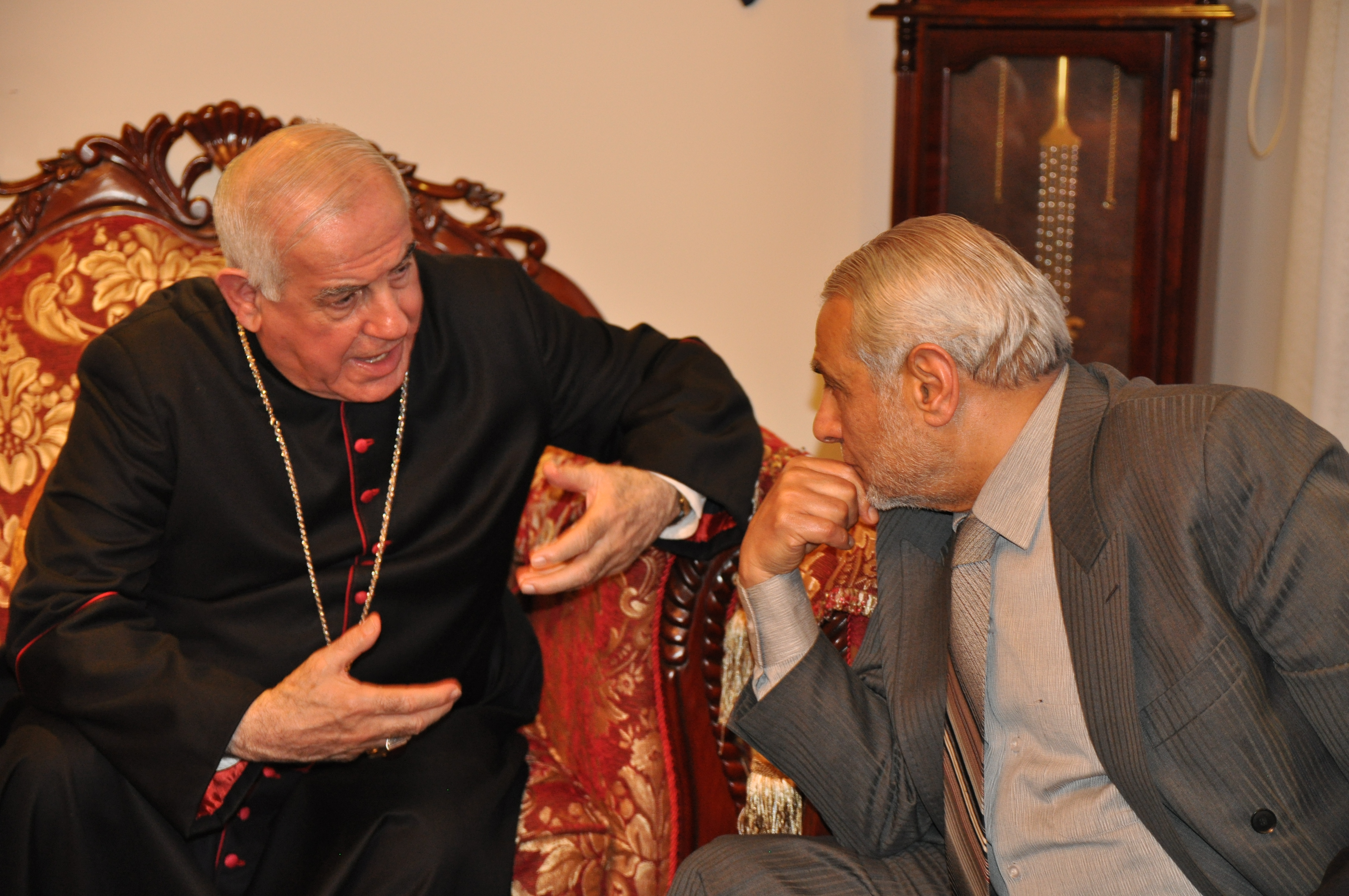
Grand Mufti Dr Ibrahim Abu Mohamed, head of the Chaldean Catholic community Archbishop Gabriel Kassab and six other religious leaders released a joint statement denouncing all forms of “violence, sectarian discrimination and terrorism, especially in Iraq and the Middle East”.

“We stand in solidarity with the displaced families in the region who have every right to live free from fear, and we pledge any support that eases their hardship,” the statement said on Thursday.

The leaders also pledged to “uphold the safety of our homeland Australia and Australian people”.

“This is an integral part of our divine teachings,” the statement said.

“We affirm our commitment to continue this solidarity and maintain open lines of communication with each other and with the Australian government.”

Joseph Wakim, of Arab Council Australia, commended the religious leaders for speaking out against violent extremism abroad.

“What they’re trying to make sure is that it doesn’t come home to Australia,” he told AAP.

Mufti-Bishop

“They’re really trying to buffer it by saying to all these angry youths who are out there trying to take the law into their own hands that they don’t have any sort of blessing (from their religious leaders).”

The statement comes amid a federal government push to tighten counter-terrorism measures.

The Abbott government says it is concerned that dozens of Australians who are fighting in Syria and Iraq might bring their extreme ideologies back home.


Plenty of smoke but little fire in Tony Abbott’s concerns over Muslim radicals

http://m.theage.com.au/comment/plenty-of-smoke-but-little-fire-in-tony-abbotts-concerns-over-muslim-radicals-20140901-10ay16.html

http://bit.ly/1B8AlGQ

Published in The Age, 2 September 2014

The Islamic State is emerging as a political movement.


The Prime Minister should be a beacon leading us out of the terrorism smoke, not fanning the flames.

Mr Abbott’s announcement that $13.4 million will be earmarked to “support community efforts to prevent young Australians being radicalised” is fraught with contradictions.

How can one allocate money to a “community” solution before we have any evidence-based research on the cause? There is no singular definable career path or pathology for the radicalised terrorist. Some are educated professionals who are drawn to ideology of a pure Islamic caliphate. Others are disenfranchised and unemployed, angry at their lack of belonging. Whether it is the pull or push factor, the allure of power and making history is a magnet for some.

The compounding factors may be idiosyncratic to the individual, compounded by their selected peers or by their selected social media. There is no evidence that the family or the “community” sanctions or supports this pathway to violent extremism. When discovered, these individuals appear to be leading a double life.

If “community” refers to Islamic organisations and mosques, they are rarely on the radar or habitat of these recluses. When was a radicalised jihadist recognised as a regular at a youth centre? These marginalised individuals appear to shy away from these “mainstream” professional agencies that encourage education and employment. Throwing the solution at the feet of Muslim community leaders implies that they are part of the problem.

While Mr Abbott is at pains to point out that his measures “are not directed against any particular community or religion”, this is refuted by his recent round of Muslim meetings. The leaders that the Prime Minister “consulted” last week while trying to sell his anti-terror reforms are the respectable officials and unlikely to be “consulted” by the radicalised jihadists.

The Attorney-General’s Living Safe Together website affirms that “there is not just one path to violent extremism”, and that “extremists exploit social and economic conditions, and individual vulnerabilities to recruit and motivate others”. However, it also affirms that “many projects are already under way across Australia under the Building Community Resilience Grants and Youth Mentoring Grants Programs”. This begs the question: has Mr Abbott announced a continuation of an existing funding?

Mr Abbott claims that “the best defence against radicalisation is through well-informed . . . local engagement”. But his concerns about returning radicalised extremists becoming “involved in terrorist activity here” may be ill-informed. ISIS is not al-Qaeda. The Islamic State is emerging as a political movement that is founded on reclaiming and expanding its own territory, commencing with Iraq and Syria.

Their enemies are infidels in their caliphate who refuse to swear allegiance to caliph Abu-Bakr al Baghdadi. Their ethnic cleansing is driven by a sense of victimisation and vengeance. As confirmed by many “rear-view mirror” empirical studies on the radicalisation process, angry political views are the prerequisite, not religious intolerance.

Unlike al-Qaeda, which launched attacks on foreign soil, this offshoot recruits fighters for its own soil. There has been no official escalation of Australia’s “medium” risk of terrorist threat since 2003. Despite this unchanged risk assessment, Mr Abbott heightens the media hype by referring to what “we have seen on our TV screens and on the front pages of our newspapers”.

If one listens to the propaganda of the travelling circus that recruits youth into the Islamic State, they are replete with references to western racism and hypocrisy.

If Mr Abbott is serious about “activities to better understand and address radicalisation”, the onus cannot be left at the feet of the “community”. Ironically, the double speak in his announcement has already fed conspiracy theories that Muslims are being targeted, yet again. The differential treatment of Australians in the Israeli Defence Forces, which have killed over 2000 Palestinians in Gaza, remain a bone of contention for many who see all killing of civilians as immoral, regardless of uniform or citizenship. The maps of Sydney CBD seized inside a “bomb-making” house in Brisbane failed to attract the usual terrorist headlines, perhaps because the suspect was not from the Middle East.

Even “moderate” Muslims have been angered by Mr Abbott’s recent ultimatum that “you don’t migrate to this country unless you want to join our team”, especially given that near half of the Muslim population was Australian-born.

Repeated references to “Team Australia” reduce these issues to a sport where the non-players are rendered non-Australian. Mr Abbott may be wise to play down the politics of fear by stating “if you have nothing to hide, you have nothing to fear”.

The hype around home-grown radicals planting bombs is real, and has been spurred by the free publicity given to Islamic State scaremongering. But planting the solution at the feet of the community is not realistic.

They need to be coupled with government efforts to stop the divisive language and foreign policies that cause the very radicalisation that the Prime Minister is ostensibly diffusing.